

why are conservative men obsessed with ancient rome?
"There’s a fascination with Spartan culture and stoic philosophers and famous thinkers like Aristotle and Plato. The men who consume this stuff — and yes, it’s almost exclusively men — tend to believe two things: that ancient Greek and Roman culture are the basis of Western civilization and that these cultures are the exclusive achievements of white men.” - Donna Zuckerberg
republicans and roman virtues
Do as I Say, Not as I Do
In an article from The Bulwark titled “The Right’s Ironic Fixation, the author explains, “Many Republicans indeed try to impart to their children something like the Roman ethic. Work hard. Be steadfast. Be reliable. Serve your country. And most of all, speak up for the truth: call things what they are. Yet Trumpism, regrettably, painfully, tragically, is driving a moral collapse at the level of the family. Parents who once promoted honesty and decency—who would strenuously deny having discarded them—have been undone by our political moment. Fathers and mothers who once said, “If Johnny jumped off a bridge, would you do it too?” now say, “But the Democrats are just as bad.” “But Obama started it.” “But absentee ballots are a concern.” “But Antifa rioted outside a courthouse.” “But Pelosi wouldn’t let Jim Jordan on the January 6th Committee.” “But Hillary’s emails!” This is now the talk of the dinner table. Projection. Deflection. False equivalence. Special pleading. A deep-seated aversion to saying what is true. These are becoming the habits of the Republican household.
The Republic Will Triumph
A citizen of the Roman Republic was expected to keep faith with the Roman polity. This meant continuing to believe, even in the teeth of repeated disaster, that the Republic would always triumph. In similar fashion, faith in the American republic and its principles was once a core plank of the GOP platform. It is bizarre, therefore, to watch Republicans (as it were) lose faith in the republic itself.
"Crossing the Rubicon"
By claiming to uphold the ideals of the Roman Republic the emerging leaders of the GOP appear ready to abandon those republican values entirely. For some time now, they've framed the current moment as one of late-stage republic decline—and the FBI’s search of Trump’s Mar-a-Lago estate only intensified this narrative. “We either have a Republic or we don’t,” declared J.D. Vance on the day of the search. Terms like “post-constitutional” are being tossed around freely. Commentator Roger Kimball openly expressed hope that the search would be the “Rubicon we’ve been waiting for”—a point of no return. To embrace the idea that the opposing side is waging a civil war, as Caesar did when crossing the Rubicon in 49 B.C., is to justify acting as if your own side must do the same. It paves the way for inciting real conflict under the guise of self-defense.
what is a roman salute?
This video debunks the myth of the "Roman salute," a gesture often believed to be a traditional greeting in Ancient Rome. The salute involves extending the right hand with the palm down, and it has become associated with fascism and Nazism due to its adoption by Italian fascists and later Nazi Germany in the 20th century. However, there is no reliable evidence that this gesture was used in Ancient Rome. The idea likely originates from the 1785 painting The Oath of the Horatii by Jacques-Louis David, where characters are depicted with outstretched arms. This gesture was later popularized in the 1914 film Cabiria, and subsequently adopted by fascist leaders like Gabriele D'Annunzio and Benito Mussolini. The salute spread further through associations with fascist movements worldwide, but it has no historical basis in Roman customs
"Roman Salute" in fascist italy
Gabriele D'Annunzio, who had written subtitles for the 1914 film Cabiria, appropriated the Roman salute when he led the Italian Regency of Carnaro in 1919. D'Annunzio is often seen as a precursor to Italian Fascism, having invented several theatrical rituals, including the salute, that later became part of the fascist movement. By 1923, Italy's Ministry of Education instituted the Roman salute as part of a flag-honoring ritual in schools. As Mussolini's regime gained power, the salute became mandatory for civil servants by 1925, with Achille Starace promoting it as a compulsory gesture, replacing handshakes. By 1932, the salute was adopted as the standard greeting, with its symbolic value growing to represent fascist ideals of decisiveness, firmness, and obedience to the regime. The salute was even used in military honors and came to symbolize the fascist regime's hierarchical structure.
The Bellamy Salute in the United States of America
The Bellamy salute, introduced on October 12, 1892, was a hand gesture to accompany the Pledge of Allegiance in the U.S., invented by James B. Upham, the junior partner of The Youth's Companion. The salute involved raising the right hand and keeping it extended while reciting the Pledge. However, as fascism rose in Europe, the Bellamy salute came under scrutiny for its similarity to the Roman salute, leading to controversy, especially during World War II. In response, some school boards adjusted the salute to avoid this association. Amid the growing controversy, Congress passed Public Law 77-623 in 1942, officially changing the salute to the right hand over the heart during the Pledge, and further amended the law later that year to completely eliminate the Bellamy salute.
michael anton's flight 93 election
What was the Flight 93 Election?
In his controversial September 2016 editorial titled "The Flight 93 Election," published under a pseudonym, Publius Decius Mus in the Claremont Review of Books, Michael Anton likened the 2016 presidential election to the hijacked Flight 93 on 9/11, arguing that conservatives had to "charge the cockpit" by supporting Donald Trump or face national ruin under Hillary Clinton. The essay harshly criticized anti-Trump conservatives, condemned immigration from "Third World" countries, dismissed concerns about Islamophobia and the Black Lives Matter movement as trivial, and claimed the left was waging cultural wars. The piece gained significant attention, including being read aloud by Rush Limbaugh on his radio show.
Who was Publius Decius Mus?
Publius Decius Mus was a Roman statesman and military leader known for his heroism and ultimate self-sacrifice. He first appears in history in 352 BC as one of five public bankers appointed to help relieve citizen debt. His military fame rose during the First Samnite War, where he heroically rescued a trapped Roman army and was awarded the prestigious Grass Crown, the highest military honor.
In 340 BC, while serving as consul during the Latin War, an oracle predicted that victory would come at the cost of a general's life. Decius Mus performed a ritual act called devotio, dedicating himself and the enemy to the gods of the underworld to ensure Roman victory. He charged into battle, was killed, and his sacrifice inspired the Romans to win decisively.
His act of devotio became legendary in Roman history, symbolizing ultimate patriotism and duty. He was the father and grandfather of two other consuls who also bore his name and continued his legacy.
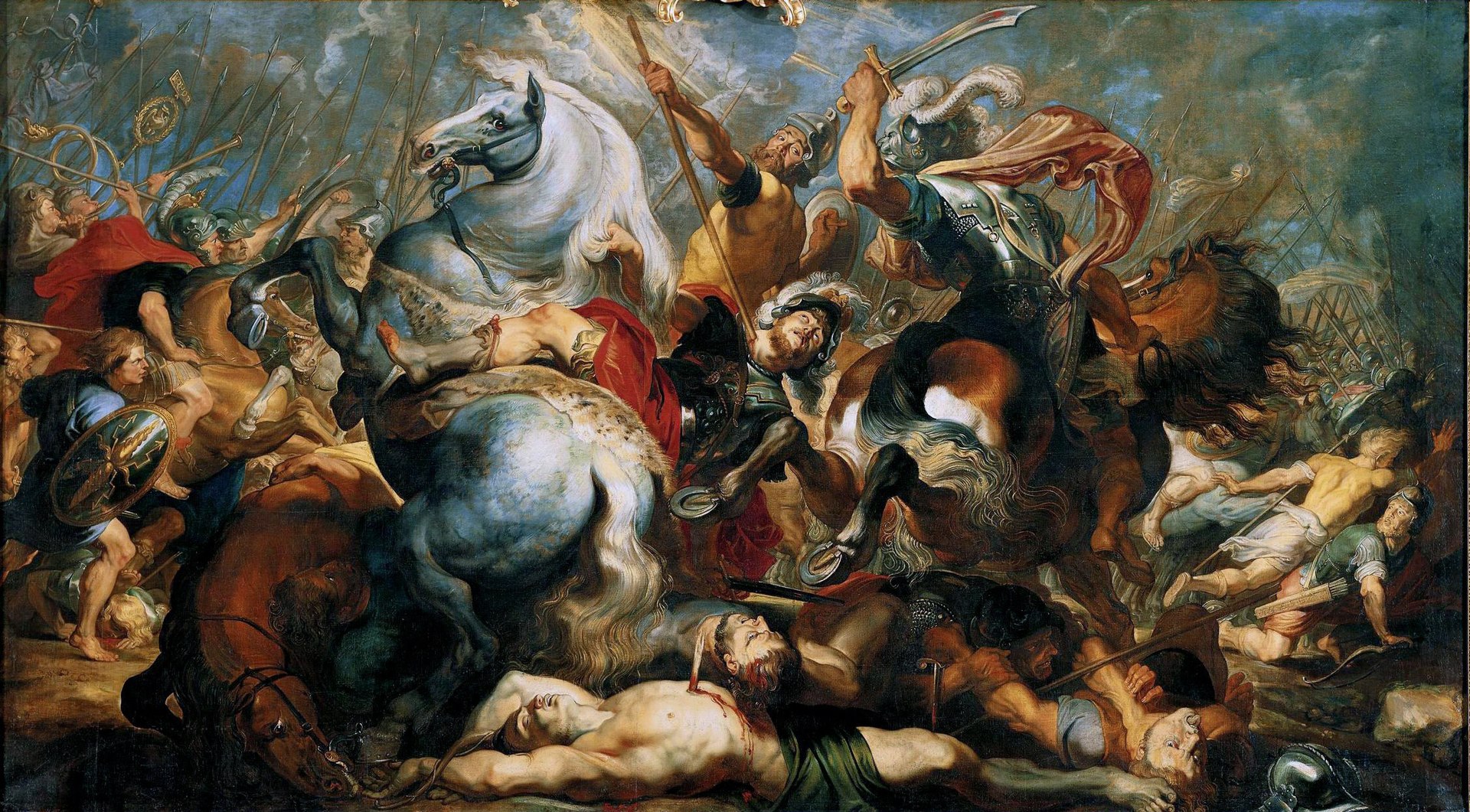
By Peter Paul Rubens - [1], Public Domain, https://commons.wikimedia.org/w/index.php?curid=5236512
Excerpts from the Flight 93 Election
“If conservatives are right about the importance of virtue, morality, religious faith, stability, character and so on in the individual; if they are right about sexual morality or what came to be termed “family values”; if they are right about the importance of education to inculcate good character and to teach the fundamentals that have defined knowledge in the West for millennia; if they are right about societal norms and public order; if they are right about the centrality of initiative, enterprise, industry, and thrift to a sound economy and a healthy society; if they are right about the soul-sapping effects of paternalistic Big Government and its cannibalization of civil society and religious institutions; if they are right about the necessity of a strong defense and prudent statesmanship in the international sphere—if they are right about the importance of all this to national health and even survival, then they must believe—mustn’t they?—that we are headed off a cliff.”
"If you haven’t noticed, our side has been losing consistently since 1988. We can win midterms, but we do nothing with them. Call ours Hannibalic victories. After the Carthaginians’ famous slaughter of a Roman army at Cannae, he failed to march on an undefended Rome, prompting his cavalry commander to complain: “you know how to win a victory, but not how to use one.” And, aside from 2004’s lackluster 50.7%, we can’t win the big ones at all."
Curtis Yarvin and Rome Comparisons
Who is Curtis Yarvin?
Curtis Yarvin, also known by his pen name Mencius Moldbug, is a far-right American blogger and founder of the neo-reactionary movement, also called the Dark Enlightenment, which advocates for replacing American democracy with a form of techno-monarchy modeled after corporate governance. Through his blog Unqualified Reservations and later newsletter Gray Mirror, Yarvin has promoted anti-democratic and anti-egalitarian ideas, including controversial views on race and support for slavery. He is also the creator of the Urbit computing platform and co-founded the tech company Tlon. His ideas have influenced prominent figures in Silicon Valley and Republican politics, including Peter Thiel, Steve Bannon, and Vice President JD Vance. In January 2025, Yarvin attended a Trump inaugural gala, where he was reportedly an informal guest of honor, reflecting his significant influence on the Trump-aligned right.
identity evropa and roman/greek symbolism
What is Identity Evropa?
Identity Evropa, a white supremacist group founded amid the nationalist fervor surrounding Donald Trump’s rise in 2016, launched a poster campaign on college campuses using classical sculptures like Michelangelo’s David to promote messages such as “Serve Your People” and “Protect Your Heritage.” While these images might resemble art-history promotional material at a glance, their underlying goal is to appeal to young, alienated white men by rebranding white nationalist ideology with a veneer of cultural sophistication. The group’s use of European art aligns with traditional fascist aesthetics, echoing the visual strategies of historical figures like Hitler and Mussolini, who favored classical imagery to promote ideals of racial purity and strength.
Normalizing Far-Right Ideologies
Despite the group’s relatively small size, their offline activism—through campaigns like #ProjectSiege—has generated tension on campuses and even sparked physical altercations, as seen at the Minneapolis Institute of Art. Identity Evropa seeks to distance itself from the overt swastikas and violent rhetoric of older hate groups, instead framing their beliefs in a polished, pseudo-intellectual style. They call themselves “identitarians” rather than white supremacists and attempt to mainstream their ideas by invoking cultural pride and European heritage, appealing to a sense of lost tradition and purpose. The Southern Poverty Law Center links the group’s founder, Nathan Damigo, with major alt-right figures like Richard Spencer and Milo Yiannopoulos, placing Identity Evropa within a broader movement to normalize far-right ideologies among younger audiences.
The Aesthetic of Whiteness
However, a closer look at the posters reveals a superficial understanding of the art they invoke. From statues of David to a funerary angel in a German cemetery, the artworks are often chosen not for historical or symbolic relevance, but for their aesthetic resonance with ideals of European whiteness and masculinity. This shallow appropriation undermines the group’s claim to cultural revival, exposing their “identity” as a patchwork of internet memes and borrowed symbolism. Rather than connecting deeply with European heritage, their use of classical imagery reflects a modern effort to make hate look cultured—an ultimately hollow gesture cloaked in marble.

Identity Evropa poster - https://news.artnet.com/art-world/identity-evropa-posters-art-symbolism-881747
roman Aesthetics under mussolini - fascist architecture
Fascism = Historical Greatness
Mussolini's Fascist regime used architecture as a powerful propaganda tool, constructing modern, minimalist buildings with hard lines and blank cement walls while redesigning streets into broad, straight boulevards. These changes symbolized a break from Italy’s medieval past and were intended to glorify Mussolini, portraying him as a heroic, decisive leader. Fascist architecture projected strength, sacrifice, and national rebirth, presenting the regime as a savior from parliamentary inefficiency. At the same time, Mussolini drew heavily on ancient Roman imagery and symbolism to legitimize his rule, evoking the idea of "Romanità"—the glorification of Rome’s imperial legacy—to connect modern Fascism with historical greatness.
Fascist Italy is the Future, Imperial Rome is the Past
Simultaneously, the regime carried out large-scale archaeological excavations and restorations of Roman ruins, further reinforcing ties to the ancient empire. Mussolini often referenced Roman victories in speeches and claimed a continuity between Fascist Italy and imperial Rome, positioning his leadership as a natural successor to that of the emperors. The combination of new construction and historical preservation was meant to forge a new identity for Italy by blending past glories with modern ambition, framing Fascism as the next chapter in Rome’s illustrious legacy.
Fascist Art
However, the regime’s aesthetic goals revealed contradictions in Fascist ideology. Mussolini's desire to create a distinctly "Fascist art" clashed with the eclectic use of both ultra-modern and classical elements. For instance, the New Museum featured ancient Roman artifacts displayed in a starkly modernist building, showcasing the regime’s inconsistent artistic vision. While the Fascists aimed to develop a cohesive aesthetic, their simultaneous promotion of radically different artistic periods—modern Rationalism and ancient Roman tradition—resulted in a disjointed and incoherent cultural message.