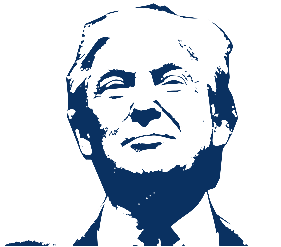
Dictator on Day One
Donald Trump has long flirted with the aesthetics, rhetoric, and behavior of authoritarianism, but recent actions and revelations point more directly to a disturbing pattern of dictatorial tendencies. From public admiration of brutal strongmen like Kim Jong Un and his desire for "loyal" generals like Hitler’s, to symbolic gestures like installing 88-foot flagpoles, a number widely recognized as neo-Nazi code for "Heil Hitler", Trump consistently signals affinity with authoritarian imagery and methods. Disturbingly, his behavior goes beyond symbolism: he has expressed interest in ruling as a "dictator on day one," proposed reopening Alcatraz for unknown purposes, and privately discussed military action without informing Congress, violating democratic norms. Whether it’s keeping Mein Kampf by his bedside, praising fascist architecture through the redesign of the Rose Garden, or echoing fascist logic by framing the liberation of Nazi Germany as “not a great day,” Trump’s actions increasingly resemble a blueprint for autocracy. Here we explore these warning signs and their chilling implications for American democracy.

Trump, before his second term, suggested that he would act as a dictator from day one if re-elected.
In a provocative statement, Donald Trump suggested that he would act as a dictator from day one if re-elected, raising serious concerns about his views on executive power and governance. This remark highlights a willingness to bypass democratic norms and checks and balances, indicating a troubling inclination toward authoritarianism. Such rhetoric has sparked significant backlash, as many fear it undermines the foundational principles of democracy, which rely on accountability and the rule of law. Trump's comments prompt a broader discussion about the importance of protecting democratic institutions in the face of potential abuses of power. Now that we are within the first year of his second term, this message served as a warning for the horrors to come.
Trump frequently references Hannibal Lecter in his speeches on immigration.
Donald Trump frequently references the fictional serial killer Hannibal Lecter during his 2024 campaign speeches, often while making false and dehumanizing claims that immigrants are being released from mental institutions into the U.S. Calling Lecter “the late, great,” Trump uses the character as a metaphor for supposed threats at the border, despite no evidence supporting such claims. His use of Lecter reflects both his fondness for 1980s cultural references—an era tied to his own rise to fame—and his talent for using vivid, provocative imagery to rally supporters. Biographers note that invoking Lecter marks an escalation in Trump’s rhetoric on immigration, moving from earlier claims of immigrants as “rapists” to comparing them to a cannibalistic killer. While some supporters interpret the reference literally and others symbolically, it consistently feeds into Trump’s flair for theatricality and shock value. The Trump campaign has not clarified the fixation, though insiders suggest it’s part of his storytelling style; meanwhile, actor Anthony Hopkins, who famously portrayed Lecter, expressed surprise and disapproval upon learning of the comparison.
Trump Praised Kim Jong Un for how his people sit at attention when he speaks.
Admiration for Authoritarian Control
In June 2018, following his historic summit with North Korean leader Kim Jong Un, President Donald Trump made controversial remarks expressing admiration for the authoritarian control Kim exercises over his people. During a live interview on Fox News, Trump commented that Kim’s people “sit up at attention” when he speaks, and added, “I want my people to do the same.” The statement drew immediate backlash, as it appeared to praise the forced obedience and cult-like reverence characteristic of North Korea's dictatorship.
I was "joking"
Later that day, Trump claimed he was joking, telling reporters, “I was kidding. You don’t understand sarcasm.” Nonetheless, the comment underscored broader concerns about Trump’s praise for Kim, whom he described as “funny,” “smart,” and “very talented.” Trump emphasized that his personal rapport with Kim was a strategic move to reduce nuclear threats, stating that his goal was to protect American families from potential devastation.
Trump wants to reopen Alcatraz prison.
President Donald Trump is moving forward with a controversial plan to reopen Alcatraz Island as a federal prison, despite widespread skepticism from experts. Last week, officials from the Federal Bureau of Prisons visited the island, and more visits are scheduled. The plan aims to house "the most ruthless and violent offenders" at the historic site.
Alcatraz closed as a federal prison in 1963 due to high maintenance costs. Critics, including California Attorney General Rob Bonta, argue that reopening the prison is unrealistic due to massive infrastructure issues and legal hurdles. GGNRA Superintendent David Smith also expressed doubts, highlighting the significant financial and logistical challenges.
The White House posted an altered version of the new Superman movie poster featuring Donald Trump as the superhero.
Shared on X on July 10, the image shows Trump in Superman’s iconic suit with phrases like “A Trump Presidency,” “Truth,” “Justice,” and “The American Way.” The post was timed to coincide with the July 11 release of DC Studios' Superman, starring David Corenswet. The film itself has also drawn attention after director James Gunn described Superman as an immigrant and symbol of American values, sparking both praise and backlash. Critics, including former Superman actor Dean Cain and Trump ally Kellyanne Conway, accused Hollywood of politicizing beloved characters. Conway argued that audiences don't want ideological messages in films, while Cain questioned how far studios would go to "modernize" iconic roles. In defense, James Gunn reaffirmed that Superman is meant for everyone, emphasizing values like kindness and inclusion. His brother, actor Sean Gunn, echoed that stance, saying that supporting immigrants aligns with true American ideals, and that those who oppose that message are “against the American way.”
Fascism experts are fleeing the United States.
Yale professor and fascism scholar Jason Stanley is leaving the U.S. to join the University of Toronto’s Munk School due to rising concerns about the U.S. political climate, which he fears is moving toward a “fascist dictatorship.” Stanley, author of How Fascism Works, cited Columbia University's capitulation to Trump administration demands, including protest crackdowns and program reviews, as a key reason for his decision. Stanley, whose family fled Nazi Germany, likened the current U.S. situation to Germany in the early 1930s. While he praised Yale faculty for resisting political pressure, he said the broader climate of government pressure on universities and academic freedom pushed him to leave. He also criticized the Department of Education’s stance on systemic racism education, calling it a step toward “educational authoritarianism.”
Trump added “Trump 2028” hats to the Trump organization's website, signifying an illegal third term.
At a recent rally in Michigan, Donald Trump escalated his attacks on the judiciary while promoting “Trump 2028” campaign hats, signaling his intention to remain a dominant political force beyond the 2024 election. While vowing to defy court rulings that block his immigration agenda, Trump criticized “Communist, radical left judges” and implied that the Supreme Court should back his efforts. Despite recent Supreme Court orders halting deportations and requiring due process for detainees, Trump has continued pushing mass removals and ignored judicial decisions. The sale of “Trump 2028” hats at the rally raised alarms among critics, who see it as part of a broader authoritarian push and a disregard for constitutional limits.