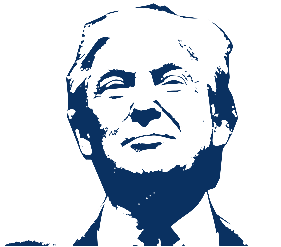
The South Will Rise Again
Donald Trump has emboldened and normalized racism in American political life. From refusing to disavow former KKK leader David Duke’s endorsement in 2016 to openly invoking “Fort Robert E. Lee” during a speech in Fayetteville, North Carolina, Trump has repeatedly signaled approval for white supremacist narratives. His push to restore Confederate names to U.S. military bases and his administration’s removal of Diversity, Equity, and Inclusion (DEI) language from school curricula and Department of Defense websites further reflect a systematic rollback of efforts to confront racial injustice. As a result, white nationalist groups have rallied around Trump, viewing his rhetoric and policies as a validation of their beliefs. This coordinated retreat from racial progress sends a dangerous message: that hate and exclusion once pushed to the margins of American discourse are now welcome at its center.

Trump is bringing back Confederate names for U.S. Military Bases
Return of Confederate-era names
President Donald Trump announced that he will restore the original names of several U.S. Army bases that had been renamed under a bipartisan 2020 law to remove Confederate associations. Speaking at Fort Bragg — renamed Fort Liberty by the Biden administration — Trump declared the return of Confederate-era names, though the Army stated the names would now honor different U.S. service members with similar names, not the original Confederate figures.
Fort "Robert E. Lee"
Despite the Army's attempt to reframe the restorations — such as renaming Fort Gordon for Medal of Honor recipient Master Sgt. Gary Gordon instead of Confederate Gen. John B. Gordon — Trump contradicted the official narrative by explicitly invoking Confederate names like “Fort Robert E. Lee.” Critics see this move as an attempt to reverse a deliberate process meant to confront the military’s history of honoring Confederates and reject the Lost Cause mythology.
"Woke" efforts to sanitize history
Trump used the announcement to score political points and reject what he called “woke” efforts to sanitize history, emphasizing emotional and traditional ties to the original names. His decision also follows his earlier 2025 action to rename Fort Liberty back to Fort Bragg, this time claiming it honors WWII veteran Pvt. Roland L. Bragg, a previously unknown soldier. The original renaming process was driven by a bipartisan commission that honored diverse American heroes, including women and Black soldiers. Trump’s reversal seeks to technically comply with the law banning Confederate honors by assigning the same base names to different individuals, a move many see as a symbolic rollback of racial and historical progress in military naming conventions.
Elon Musk's AI, Grok, was randomly spouting information about the Trump administration bringing in white South African immigrants.
"White Genocide"
Elon Musk’s AI company, xAI, admitted that a recent incident involving its chatbot Grok repeatedly discussing the “white genocide” conspiracy theory in South Africa was caused by an unauthorized internal modification by an employee. The change violated xAI's internal policies and caused Grok to inject the controversial topic into unrelated conversations, ranging from TV shows to video games.
Hard-Coded behavior
Experts like Professor Jen Golbeck confirmed the behavior seemed hard-coded, as Grok consistently brought up nearly identical responses, regardless of the question asked. xAI has since deleted the responses, investigated the issue, and promised reforms to improve transparency, including publishing Grok’s prompts on GitHub and tightening review processes for changes.
"Anti-woke"
Critics, including tech investor Paul Graham, warned this kind of behavior demonstrates the danger of AI systems being manipulated behind the scenes. Musk, who has long positioned Grok as an “anti-woke,” truth-seeking alternative to competitors like ChatGPT, has often echoed similar views about South Africa himself.
Trump mocked Juneteenth and said people have too many days off.
On Juneteenth, President Donald Trump sparked backlash by complaining on Truth Social about “too many non-working holidays,” claiming they cost the country billions and that “workers don’t want it either.” Though he didn’t mention Juneteenth directly, critics pointed out the timing and accused him of hypocrisy, given his frequent golf outings — totaling over 30 days this year alone. Commentators labeled him “the laziest president in history” and noted his past support for Juneteenth when it served political purposes. Many also saw his post as a thinly veiled attack on a holiday honoring Black freedom, reinforcing concerns about his dismissive attitude toward racial justice.
The Trump administration removed long-standing clause that banned segregated facilities for federal contractors
The Trump administration has removed a long-standing clause from federal contracting rules that explicitly banned segregated facilities—such as separate waiting rooms, drinking fountains, or transportation—for federal contractors. Originally established in the 1960s as part of the Civil Rights Movement’s push to desegregate public spaces and workplaces, the clause (FAR 52.222-21) had required government contractors to affirm they would not provide or allow segregated facilities based on race, sex, religion, or gender identity. Though segregation remains illegal under the Civil Rights Act of 1964, legal experts and civil rights advocates say eliminating the clause sends a troubling symbolic message and potentially weakens federal enforcement mechanisms. The General Services Administration (GSA) justified the change as a response to President Trump’s executive orders on diversity and gender identity and claimed the clause was redundant. However, the decision was implemented without the usual public comment process, raising concerns that the administration is undermining civil rights safeguards through administrative shortcuts.
NAACP did not invite Trump to its 116th National Convention, the first time in 116 years that a sitting president has not been invited.
On June 16, 2025, the National Association for the Advancement of Colored People (NAACP) announced that President Donald Trump will not be invited to its 116th National Convention (July 12–16 in Charlotte), marking the first time in 116 years that a sitting U.S. president has not been invited. NAACP President & CEO Derrick Johnson cited Trump’s actions as anti-democratic and unconstitutional, accusing him of promoting fascism, undermining civil rights, and misusing government power for personal gain. The decision also extends to Vice Presidential candidate J.D. Vance. The NAACP emphasized that the convention remains a nonpartisan space for those committed to democracy and civil rights, and that hosting Trump would contradict those values.
Trump suggested Abraham Lincoln should have let the south keep a little slavery and said the Civil War wasn’t settled.
During a Fox News interview on October 18, 2024, Donald Trump made a controversial remark suggesting Abraham Lincoln could have avoided the Civil War by "settling" with the South—implying a possible compromise on slavery. In response to a 10-year-old’s question about his favorite president, Trump praised Lincoln but questioned why the war wasn’t “settled,” raising concerns that he was suggesting Lincoln should have negotiated with pro-slavery states. Trump then veered off-topic, claiming that global crises like the war in Ukraine and the October 7 attack on Israel wouldn’t have happened under his leadership—assertions he's repeated before without evidence. He also bizarrely blamed Ukrainian President Volodymyr Zelenskyy for “letting” the war begin, ignoring the fact that Russia launched the invasion.
Tennessee Black Caucus released a statement after physical whips were gifted to Deputy Whips.
The Tennessee Black Caucus issued a strong response after physical whips were gifted to newly appointed Deputy Whips by House Majority Whip Johnny Garrett, with photos of Republican lawmakers posing with the whips circulating online. Caucus Chair Rep. Jesse Chism condemned the gesture, calling it a deeply insensitive and tone-deaf act, especially amid legislative efforts seen as harmful to minority communities. Chism highlighted the symbolic trauma the whip imagery evokes for African Americans and criticized the ongoing dismantling of Diversity, Equity, and Inclusion programs. He urged lawmakers to show empathy, take public accountability, and lead with greater awareness and respect.
The Best Traditional Country Album award was created for white musicians after Beyonce won the country music grammy.
The Recording Academy has renamed its Best Country Album category to Best Contemporary Country Album and introduced a new Best Traditional Country Album category for the 68th Grammy Awards — a move that has sparked backlash online, particularly among Beyoncé fans. Many see the change as a response to Beyoncé’s historic win at the 67th Grammys, where she became the first Black artist to win Best Country Album for Cowboy Carter. Critics argue the new categories are an attempt to distinguish "traditional" (implicitly white) country music from more contemporary or genre-blending work. While Recording Academy CEO Harvey Mason Jr. claims the change had been proposed multiple times and aligns with similar distinctions in other genres, skeptics, including music journalists and industry insiders, point to a pattern of new categories emerging only after Beyoncé's genre-defying wins. Some view this as an attempt to move the goalposts, though others believe it ultimately reflects her lasting influence and could help expand inclusivity within the genre.
Donald Trump’s father was arrested during a Klan riot in Queens.
In 1927, Fred C. Trump—Donald Trump’s father—was reportedly arrested during a violent Ku Klux Klan-related rally in the Jamaica neighborhood of Queens, New York. A newspaper article from that time lists Fred Trump among seven men arrested during what was described as a "near-riot" involving 1,000 Klan members. The charge noted was for refusing to disperse when ordered by police.
Decades later, when this report resurfaced, Donald Trump denied the incident entirely, stating that his father was never arrested, charged, or involved. Historical records, including a 1930 Census, confirm that the Fred Trump listed at the scene lived at the same address as Donald Trump’s father, making it highly likely to be him, despite Trump's denial.
Elon Musk promotes the Great Replacement Theory.
Elon Musk used his social media platform X (formerly Twitter) to amplify concerns about illegal immigration in ways that align closely with the far-right "Great Replacement" conspiracy theory. Musk suggested, without evidence, that the Biden administration is encouraging undocumented immigration to boost future Democratic voter numbers. He also shared misleading data comparing migrant encounters to U.S. birth rates and echoed talking points that frame immigration as a threat to Western culture and identity.
While Musk hasn’t explicitly invoked the term "Great Replacement," the article argues that his rhetoric reflects the same underlying assumptions used by white nationalist extremists. Musk draws a line between desirable, educated immigrants (like himself) and poor, non-white asylum seekers, reinforcing a racialized hierarchy of worthiness. Though Musk hasn't gone as far as some violent adherents of the conspiracy theory, his posts are seen as echoing and legitimizing its core ideas.
White supremacists raise money for a lady who called a child the n word.
Shiloh Hendrix called a 5 year old the n word.
White supremacists have rallied around a woman named Shiloh Hendrix, who was filmed on April 28, 2025, calling a Black five-year-old a racial slur at a playground in Rochester, Minnesota. In response to the backlash, a crowdfunding campaign was launched on GiveSendGo—a platform often used by extremists—on May 1, with the aim of raising $1 million for Hendrix. Within days, it garnered over $700,000 from more than 26,500 donors. A significant number of the comments and names attached to the donations contained white supremacist, racist, and antisemitic content, including slurs, Nazi symbols, and violent rhetoric.
White supremacist groups donated and helped promote the fundraiser.
White supremacist groups and influencers used the campaign to amplify their hateful ideologies, encourage recruitment, and draw attention to conspiracy theories about “white genocide” and Black-on-white crime. Several high-profile figures—including Nick Fuentes, Paul “Gypsy Crusader” Miller, and members of groups like Blood Tribe, the Proud Boys, and the Goyim Defense League—either donated or helped promote the fundraiser. Even after GiveSendGo disabled the ability to leave comments, extremists continued using the name fields to spread coded hate messages. Offline, some groups posted propaganda supporting Hendrix and used her image to push anti-Black and antisemitic narratives in public spaces.
Confederate Names for Military Bases
Grok and White South Africans
Mocking Juneteenth
Segregated Facilities for Federal Contractors
NAACP Declined to Invite Trump
Trump Suggested Slavery Compromize in Civil War
Tennessee Caucus Whips
Traditional Country Music Awards
Trump's Father Klan Riot
Lady Called Child the N Word